What does 3000mg mean on shilajit gummies?
On Himalla’s gummies, 3000 mg is raw material, not what you chew. Shilajit is a mountain resin. The panel reads 3000 mg of resin from 300 mg of 10:1 extract, so two gummies hold 300 mg. The big number is on the front, the real one on the back. Compare extract milligrams instead. Verified November 2, 2026.
Shilajit is a tar-like resin scraped from mountain rock. Brands buy it, purify it, and often concentrate it into an extract. The number printed in large type on the front of a bottle is frequently the weight of the material they started with, not the weight of what you swallow.
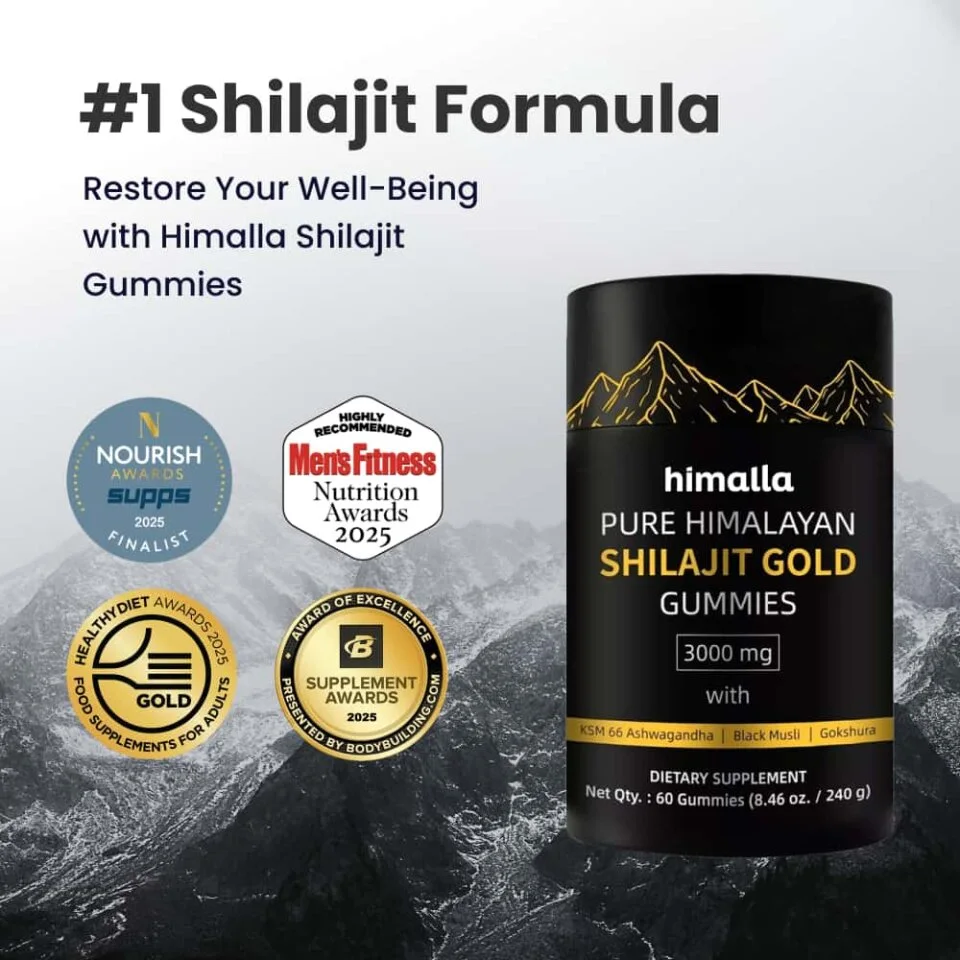
How does a 10:1 extract turn into 3000 mg?
A 10:1 ratio means roughly ten parts of raw shilajit were used to make one part of extract. Multiply the 300 mg of extract by ten and you reach the 3000 mg on the front. It is a manufacturing claim you cannot verify from the label, and it says nothing about how much fulvic acid is inside.
Think of boiling ten cups of tea down to one. The one cup is stronger, but it is still one cup. Extract ratios work the same way: the number goes up on paper while the physical amount in the gummy stays small.
| Number | Where it appears | What it is |
|---|---|---|
| 3000 mg | Front of the bottle and the first line of the panel | The raw material the extract was made from, per serving |
| 300 mg | The small print next to it | The 10:1 extract actually in a two-gummy serving |
| 150 mg | Our arithmetic (300 mg ÷ 2) | Extract in a single gummy |
| 8 g | Serving size on the panel | The weight of two gummies, of which 0.3 g is the extract |
This is standard extract labeling, and it is not a lie. The risk is comparison. A brand that prints its honest raw-milligram figure and a brand that prints extract-equivalent milligrams look nothing alike on a shelf, yet one may contain ten times more of the real thing.
Is 300 mg of shilajit extract a real dose?
It sits inside the 250 to 500 mg a day used in published human trials, but near the bottom. In one 8-week trial only the 500 mg group differed from placebo, and only in a subgroup; the 250 mg group did not. No trial has tested this gummy, so call 300 mg plausible, not proven.
Two small trials of purified shilajit are the ones most often quoted. Neither tested a gummy, and both are narrow in who they studied.
| Trial | Dose per day | Length | Who | What to keep in mind |
|---|---|---|---|---|
| Keller et al., 2019J Int Soc Sports Nutr | 250 mg or 500 mg vs placebo | 8 weeks | 63 recreationally active men, 21 per group | Measured the drop in strength after fatiguing leg exercise. In the upper half of participants by baseline strength, only the 500 mg group differed from placebo. Used a branded ingredient, PrimaVie. |
| Pandit et al., 2016Andrologia | 250 mg twice a day (500 mg total) vs placebo | 90 days | Healthy volunteers aged 45 to 55 | Measured testosterone and DHEAS. Reported higher total and free testosterone than placebo, with LH and FSH maintained. |
Both rows summarize the published abstracts. This is not a recommendation to take any amount, and neither trial shows what a particular gummy will do for you.
Here is the honest reading for someone holding a bottle. The doses that showed an effect in these studies were 500 mg a day, not 300. Neither paper says whether Himalla’s extract matches the extract they used. And both are small. The 300 mg figure is a reasonable amount, not a proven one.
This article explains one number. The review goes through all the others, scores the product on seven criteria and shows what a first order really costs.
Read the full Himalla Shilajit Gummies review, with the label and every price tierWhy is an 8 g serving only 0.3 g of shilajit?
Because most of each gummy is fiber base. Two gummies weigh 8 g, and the panel lists 5.52 g of fiber, about 69% of the serving, against 0.3 g of shilajit extract, about 4%. Sugar is 0.53 g, none of it added. The fiber base keeps sugar low. It also means you are chewing mostly base, not extract.
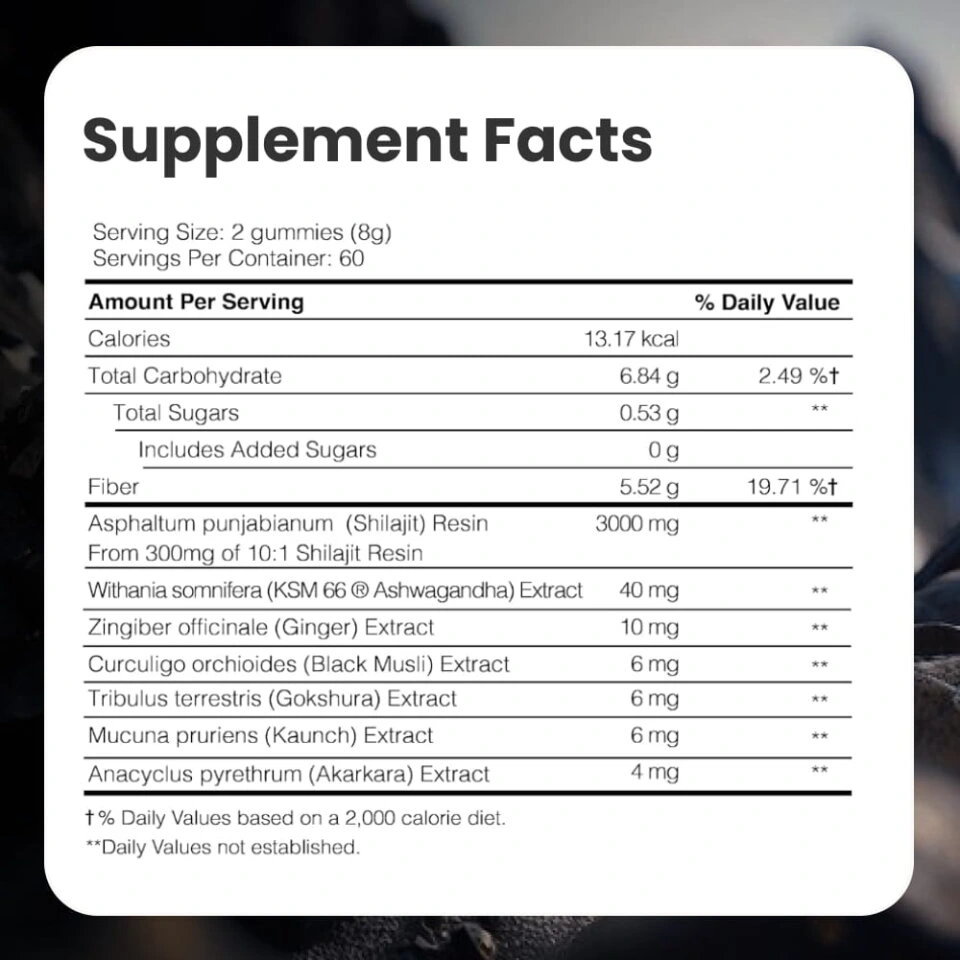
The practical lesson is to judge a gummy by the milligrams of extract it declares, not by its weight or its size. The rest of the panel, ingredient by ingredient, is scored in the review’s dose-by-dose label breakdown.
Is there a label contradiction nobody mentions?
Yes. The bottle says 60 gummies (240 g), while the panel says 60 servings per container. At two gummies per serving, 60 gummies is 30 servings, and 240 g divided by the 8 g serving agrees. Plan on one bottle per month, not two, or your cost per day will look half what it is.
It is a small error, and it is the kind that quietly flatters the price. If you read “60 servings” and divide the bottle price by 60, you will believe you are paying about half of what you really pay each day. We used the cautious reading, 30 days per bottle, for every price calculation in the review.
How do you compare shilajit gummy labels fairly?
Compare three numbers: milligrams of extract per day, the extract ratio, and cost per day. Ignore the headline milligrams. On Himalla’s gummies that is 300 mg of 10:1 extract for about $2.50 a day with one bottle, or about $1.05 a day with six, shipping included. Check live prices before you buy.
- Find the extract amount and ratio. If a label gives one big number and no ratio, you cannot tell raw material from extract.
- Ask what is actually in it. When ConsumerLab tested eight shilajit supplements in 2024, fulvic acid ranged from 6.9 mg to 2,206 mg per serving, and one product could not be approved because it contained far higher amounts than expected from its label. The firm notes that fulvic acid amounts are typically not listed on labels at all (ConsumerLab, September 26, 2024).
- Work out cost per day, not per bottle. One bottle at $69.99 plus $4.99 shipping, over 30 days, is about $2.50 a day. Six bottles at $179.94 plus $8.99, over 180 days, is about $1.05 a day. Prices checked at the official checkout on November 2, 2026 and subject to change.
- Read the return rule before the price. The 30-day guarantee on this product covers sealed bottles, not an opened one, and the buyer pays return shipping.
What should a shilajit label show about heavy metals?
A batch-level lab report with results for lead, arsenic, cadmium and mercury. Raw shilajit can carry metals from the rock it comes from, so purification and testing matter. ConsumerLab found all eight products it tested beneath levels of concern at one daily dose. That is a sample, not a certificate for your batch. Ask for the report.
Reassurance about a category is not proof about a bottle. If you plan to take any shilajit product daily for months, ask the brand’s support team for the certificate of analysis covering your batch. A company that tests every batch should be able to send it in a day.
Who should avoid shilajit gummies, and the side effects people report, are covered in the review’s safety section. If you are pregnant, breastfeeding, managing a medical condition or taking medication, talk to a doctor before starting any supplement.
Frequently asked questions
Is 3000mg of shilajit a lot?
Not as printed. On Himalla’s gummies the 3000 mg is extract-equivalent, meaning 300 mg of 10:1 extract multiplied by ten. A serving contains 300 mg of extract. Published trials of purified shilajit used 250 to 500 mg a day, so 300 mg is a plausible amount, not an unusually large one.
How much shilajit should I look for on a gummy label?
Look for milligrams of extract per day and the ratio, not the headline number. Published human trials used 250 to 500 mg a day of a purified shilajit, which is research, not advice. Also look for third-party testing, because ConsumerLab found fulvic acid ranging from 6.9 to 2,206 mg per serving across eight products.
Does 10:1 mean ten times stronger?
It means about ten parts of raw material went into each part of extract, so the extract is more concentrated. It does not guarantee ten times the fulvic acid or any other compound, because that depends on the raw resin and the processing. The ratio is the maker’s statement, and a label cannot prove it.
How long does one bottle of Himalla shilajit gummies last?
About 30 days. The bottle states 60 gummies (240 g) and the directions say two gummies a day. The panel’s claim of 60 servings per container contradicts this, since 240 g divided by the 8 g serving is 30. Use 30 days for any price-per-day math, and check the live label before buying.
Are shilajit gummies better than resin?
Neither wins on paper. Resin is sticky and bitter, while a gummy gives a fixed, labeled amount you may actually keep taking. ConsumerLab found resins contained far less fulvic acid than extracts in capsules and pills, but that is one test of eight products. Compare milligrams of extract, not format.
Where can I check the current price of Himalla Shilajit Gummies?
On the official checkout, where the prices in this article were read on November 2, 2026. The brand’s sales page publishes none. Our review lists every package, the shipping fees and the return rules in one place: read the full Himalla Shilajit Gummies review, with prices and return rules.
Is the 3000mg claim honest?
It is arithmetic, not a lie, but it invites the wrong comparison. The number that matters is 300 mg of 10:1 extract per serving, which is a plausible amount with no trial behind this exact gummy. Start with one sealed bottle if you try it.
Everything else, from the price tiers to the return rules and the score, is in the full Himalla Shilajit Gummies review.
Read the Full Review